Transfer a car title after death in Ohio: the BMV 3773 spouse affidavit covers cars worth up to $65,000 combined; other heirs need a TOD title, a court release or an executor
In Ohio, a car titled only in the name of a married resident who died can pass to the surviving spouse without probate: the spouse files the Clerk of Courts Surviving Spouse Affidavit (form BMV 3773, revision 12/25) and an Application for Certificate of Title (form BMV 3774, revision 12/25) at a county Clerk of Courts title office, for vehicles worth up to $65,000 combined under R.C. 2106.18. Other heirs need a transfer-on-death title (BMV 3811), a probate court release from administration, or an executor or administrator to sign. The title fee is $18, or $23 in counties that add a charge. All figures were checked on 2026-10-31.
- Where titles are issued
- County Clerk of Courts title offices, not the BMV
- Spouse route
- BMV 3773 (12/25) with BMV 3774 (12/25); R.C. 2106.18 and 4505.10(B)
- Spouse value cap
- $65,000 combined (plus one boat and one outboard motor)
- Transfer on death
- Beneficiary named during life on BMV 3811 (12/25); R.C. 2131.13
- Heirs without a spouse route
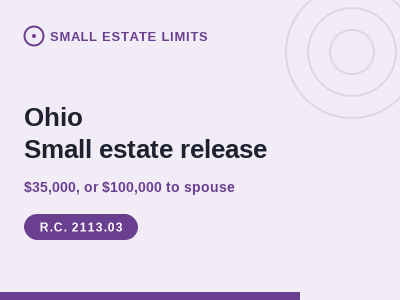
- Release from administration in the county probate court ($35,000, or $100,000 if the spouse takes all)
- Executor or administrator
- Assigns the title with a certified copy of the appointment
- Title fee
- $18 statewide; $23 where the county approves (R.C. 4505.09)
- Late fee
- $5 if the title is not applied for within 30 days of assignment
- Notary
- BMV 3773, BMV 3774 and BMV 3811 each carry a notary jurat
- Waiting period
- None stated in R.C. 2106.18, 4505.10 or on the BMV page
- Loans on the car
- Liens carry forward to the new title
Figures above were read from the Ohio BMV, the BMV form PDFs, the Ohio Revised Code, the Ohio Department of Taxation and the Tuscarawas County Clerk of Courts on 2026-10-31. See sources.
This page is general information, not legal or tax advice. Which route fits depends on how the title was held, whether there is a will, and the facts of the estate.
The five ways an Ohio title moves after the owner dies
Ohio titles are handled by the clerk of courts in each county. The BMV page on transfers at death says: "Ohio titles are issued by Clerk of Courts title offices, the BMV does not issue titles." Which route applies depends first on what the title already says.
| Route | Who applies | Forms and papers | Limit | Probate court? |
|---|---|---|---|---|
| Surviving spouse (R.C. 2106.18) | The surviving spouse of a married Ohio resident | BMV 3773 and BMV 3774, certified death certificate, title number if any, security agreement if any | $65,000 combined; one boat and one outboard motor | No |
| Transfer-on-death beneficiary (R.C. 2131.13) | The beneficiary named on the title | Original title, certified death certificate, BMV 3774, ID | None stated | No |
| Joint owner with right of survivorship (R.C. 2131.12) | The surviving co-owner | Original title, certified death certificate, ID | None stated | No |
| Heirs, small estate (R.C. 2113.03) | The person named in the release order | Certified copy of the release from administration, original title | $35,000 of estate assets, or $100,000 if the spouse takes all | Yes (release order) |
| Executor or administrator with letters | The heir or buyer, on the executor's assignment | Title assigned by the executor, certified copy of the appointment | None for the title transfer | Yes (full administration) |
Surviving spouse: BMV 3773 and the $65,000 cap
R.C. 2106.18(A) lets the surviving spouse of a married resident select one or more of the deceased spouse's automobiles. The statute says the total of their values "shall not exceed sixty-five thousand dollars", and each car that passes this way "shall not be considered an estate asset and shall not be included in the estate inventory." A motorcycle counts as an automobile, and so does a truck the family used for transportation (R.C. 2106.18(D)).
The route does not cover a car that already passes by joint ownership with right of survivorship, by a transfer-on-death designation, or by a specific gift in the will. The BMV page says the spouse "may transfer an unlimited number of vehicles valued up to $65,000 and one boat and one outboard motor".
The affidavit itself, BMV 3773 (printed revision 12/25), is headed with the county Court of Common Pleas and the Clerk of Courts, and cites R.C. 2106.18 and 4505.10. One affidavit describes one vehicle (VIN, make, model description, year, Ohio title number and approximate value). In it the spouse swears that "the combined, approximate value of the automobiles does not exceed $65,000.00" when more than one car is being transferred, that the car is not passing under R.C. 2131.12 or 2131.13 or by will, and that the spouse is entitled to it under R.C. 2106.18. It is signed before a notary public or other officer authorized by law. R.C. 4505.10(B) requires the affidavit to give the date of death and a description and approximate value of each car.
The BMV lists what the spouse brings to the title office:
- The original Ohio certificate of title number (if applicable)
- A certified copy of the death certificate
- BMV 3774, Application(s) for Certificate of Title to a Motor Vehicle
- BMV 3773, Clerk of Courts Surviving Spouse Affidavit
- A copy of the security agreement, if there is a loan
- Identification acceptable to the county title office, and the title fee
If the paper title cannot be found, the Tuscarawas County Clerk of Courts says: "It is not necessary for a Surviving spouse to obtain a duplicate title if the original certificate of title cannot be found." That clerk transfers the title from its records on the affidavit and application. Practice in other counties was not checked.
Transfer on death and joint titles
An owner can name a beneficiary on an Ohio title during life with form BMV 3811, the Transfer on Death Beneficiary Designation / Removal Affidavit (revision 12/25), signed before a notary and filed with a clerk of courts title office. The current text of R.C. 2131.13 (effective June 30, 2021) also lets two owners with right of survivorship name a beneficiary together. When the owner dies, the BMV says the beneficiary brings the original Ohio title, a certified copy of the death certificate, BMV 3774, a government-issued ID and the title fee.
For a title held jointly with right of survivorship and a beneficiary, the BMV page says: "In order for a TOD beneficiary to receive rights to the title, both titled owners must be deceased and both certified death certificates must be presented." If the named beneficiary died first, R.C. 2131.13(F)(2) says the vehicle "shall be included in the probate estate of the deceased owner."
For a joint title without right of survivorship (shown as "John Doe and Mary Smith"), the BMV says that if one owner has died, "the signature of an executor or an administrator is required".
Heirs without a spouse route: release from administration
When the spouse route, a TOD title and a joint title do not apply, the car is part of the estate. For a small estate, the Tuscarawas County clerk describes the probate court's release from administration: the heir takes "a certified copy of the release form" with a full description of the vehicle and the transferee's name, together with the original Ohio title, to the clerk's title office. The release limits are $35,000 of estate assets, or $100,000 when the surviving spouse takes everything (R.C. 2113.03). Forms, notice, fees and the cheaper summary release are on our Ohio release from administration page.
Executor or administrator with letters
Where an estate is opened in probate court, the executor or administrator signs for the dead owner. The Tuscarawas County clerk says: "The Executor should give the properly assigned Ohio title and a certified copy of the appointment of the Executor to the heir or the buyer." The heir or buyer then applies for a title in their own name within 30 days of the assignment.
R.C. 2106.18 sets when court approval is needed. With the probate court's approval, the executor or administrator may transfer a car to the surviving spouse buying it under R.C. 2106.16, to a distributee or to a purchaser. Without court approval, the executor or administrator may transfer it to a legatee entitled to it under the will, to a distributee where distribution is made without court order under R.C. 2113.55, or to a purchaser where the sale is made under R.C. 2113.39.
If the title is lost, the same clerk's page says: "If a duplicate title is needed, the administrator, commissioner, executor or executrix of the estate may sign the application by presenting the letter of appointment." BMV 3774 includes the duplicate title application.
Fees, deadline and sales tax
| Item | Amount or rule | Source |
|---|---|---|
| Certificate of title | $18; $23 where the board of county commissioners approves | R.C. 4505.09(A)(1)(b); BMV fees page |
| Late application | $5 if not applied for within 30 days after assignment or delivery | R.C. 4505.09(A)(1)(a); BMV 3774 |
| Filing deadline | 30 days after the assignment or delivery of the vehicle | R.C. 4505.06(A)(5)(b) |
| Sales tax on inheritance | Exemption code IH, "Inheritance with no Consideration" | Ohio Department of Taxation |
| Liens | Carried forward; not removed by the transfer | R.C. 4505.10(B) to (D); BMV page |
The BMV fees page says: "The $18 title fee applies statewide." The Department of Taxation describes code IH as applying "on the transfer of title to a beneficiary, including a surviving spouse, through inheritance in the administration of an estate by Probate Court." Its general exemption note lists "IH: Inheritance with no consideration, includes surviving spouse" among court-ordered transfers with no consideration.
When the car still has a loan
None of the routes clears a loan. For the spouse route, the BMV says: "This transfer does not affect any liens upon the vehicle." R.C. 4505.10 says the same for spouse, survivorship and TOD transfers, and for transfers by operation of law the new title shows any lien on the clerk's records "unless the application is accompanied by proper evidence of its extinction." When a loan is paid off, the BMV lien release page says the lender releases the lien either on the paper title or electronically through Ohio's Electronic Lien and Title Program; after an electronic release, a paper title is applied for at a clerk of courts title office.
How an heir sells the car in Ohio
A used car in Ohio is sold by assigning the title. The BMV's used vehicle page says the seller completes the assignment of ownership on the back of the title "and have their signature(s) notarized", then gives it to the buyer, who applies at a title office and pays sales tax on the price.
- Executor or administrator: may assign the dead owner's title directly to the buyer, with a certified copy of the appointment, as quoted above. Court approval is required unless one of the R.C. 2106.18(C) cases applies.
- Spouse, TOD beneficiary, joint survivor, heir under a release: the BMV and clerk pages we read describe a new title issued in that person's name; none describes that person signing the dead owner's title straight to a buyer. Once titled, they sell as any owner does.
- Electronic titles: when the title is held electronically, the BMV says the seller uses form BMV 3770 (Ownership Assignment and Title Application for Casual Sale), signed before a notary, instead of the back of a paper title.
What we could not confirm
- Whether a single car worth more than $65,000 can pass on BMV 3773. The form's $65,000 statement refers to cases where more than one car is transferred; R.C. 2106.18(A) caps the total value of the cars the spouse selects. We found no BMV statement on a single car above the cap.
- Franklin County Clerk of Courts auto title pages (surviving spouse page and FAQ) refused our requests (HTTP 403), so the Columbus office's local requirements and notary charges are not confirmed. We read only the Tuscarawas County clerk's page for local practice.
- Whether the IH tax exemption is used for a spouse transfer under R.C. 2106.18 that has no probate case. The Department of Taxation's description mentions administration of an estate by probate court; we did not find a separate statement for the affidavit route.
- Whether clerks accept remote online notarization of BMV 3773 or BMV 3774. The forms and the BMV page do not address it.
Questions
How do you transfer a car title after death in Ohio?
What is the Ohio surviving spouse affidavit for a vehicle?
Can I transfer a car title in Ohio without probate?
How much does it cost to transfer a title after death in Ohio?
Can an executor sell the car without putting it in their own name?
Other states: see car title transfer after death by state and small estate limits by state.
Sources
- Transfer a Title: Transfer on Death, Survivorship and Transfer to a Surviving Spouse - Ohio BMV, read 2026-10-31
- Form BMV 3773 (12/25), Clerk of Courts Surviving Spouse Affidavit - Ohio Department of Public Safety (PDF), read 2026-10-31
- Form BMV 3774 (12/25), Application(s) for Certificate of Title to a Motor Vehicle - Ohio Department of Public Safety (PDF), read 2026-10-31
- Form BMV 3811 (12/25), Transfer on Death Beneficiary Designation / Removal Affidavit - Ohio Department of Public Safety (PDF), read 2026-10-31
- Title Fees - Ohio BMV, read 2026-10-31
- How to Title: New and Used Motor Vehicles - Ohio BMV, read 2026-10-31
- Lien Release and Title - Ohio BMV, read 2026-10-31
- R.C. 2106.18, transfer of automobile titles - Ohio Laws (codes.ohio.gov), read 2026-10-31
- R.C. 2131.13, transfer-on-death of motor vehicle - Ohio Laws (codes.ohio.gov), read 2026-10-31
- R.C. 4505.10, certificate of title when ownership changed by operation of law - Ohio Laws (codes.ohio.gov), read 2026-10-31
- R.C. 4505.09, clerk title fees - Ohio Laws (codes.ohio.gov), read 2026-10-31
- R.C. 4505.06, application for certificate of title - Ohio Laws (codes.ohio.gov), read 2026-10-31
- Sales Tax for Motor Vehicles, Watercraft, and Aircraft (exemption codes) - Ohio Department of Taxation, read 2026-10-31
- Surviving Spouses, Right of Survivorship, Transfer on Death, Trusts and Estates - Tuscarawas County Clerk of Courts, read 2026-10-31
Source links are not affiliate links. This page is general information, not legal, tax or financial advice.