Small estate limits by state: the 10 largest states, checked October 11, 2026
In the ten most populous states, the dollar limit on the main small-estate procedure runs from $20,000 in North Carolina to $208,850 in California, and Georgia's standard form for its no-administration petition states no dollar limit. Four of the ten raised their main figure in 2025 or 2026: California (April 1, 2025), Illinois (August 15, 2025), Michigan ($53,000 for 2026 deaths) and Florida (July 1, 2026). Every row below was checked on 2026-10-11 against official statute text, session laws or the state courts' own materials.
- States covered
- 10 (the largest by population, Census Bureau Vintage 2025)
- Highest dollar limit
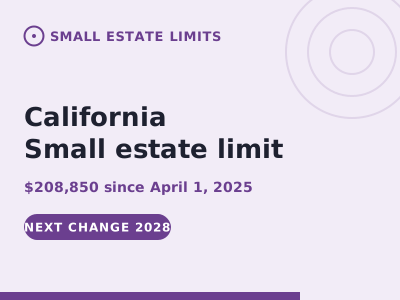
- California, $208,850 (affidavit, deaths on or after April 1, 2025)
- Lowest dollar limit
- North Carolina, $20,000 ($30,000 for a surviving spouse who takes everything)
- No dollar limit on the standard form
- Georgia, petition for order declaring no administration necessary
- Raised in 2025 or 2026
- California, Illinois, Michigan, Florida
- Affidavit handed to the holder, no court filing
- California, Illinois, Michigan
- Checked
- 2026-10-11
Figures above were read from each state's official statute text or state court materials on 2026-10-11; the population ranking is from the U.S. Census Bureau's January 27, 2026 release. See sources.
This page is general information, not legal advice. Each state's rules depend on the facts of the estate; a probate attorney or the local court's self-help center can help with a specific case.
Small estate limits in the 10 largest states
| State | Procedure | Dollar limit | Left out of the limit | Waiting period | Real estate | Law | Checked |
|---|---|---|---|---|---|---|---|
| California | Small estate affidavit or declaration; no court filing | $208,850 for deaths on or after Apr. 1, 2025 ($184,500 for Apr. 1, 2022 to Mar. 31, 2025) | Property described in Prob. Code § 13050 (such as joint tenancy, trust property and vehicles) and property in a § 13151 petition | 40 days | No; separate procedures up to $69,625 (§ 13200) or a primary residence up to $750,000 (§ 13151) | Prob. Code §§ 13100-13101; Judicial Council § 890 table | 2026-10-11 |
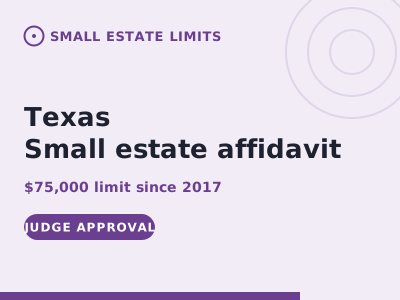
| Texas | Small estate affidavit, filed with the clerk and approved by a judge; intestate estates only | $75,000, valued on the date of the affidavit | Homestead and exempt property (§§ 205.009, 353.051) | 30 days | Only the homestead, if it is the only real property | Estates Code §§ 205.001-205.009 | 2026-10-11 |
| Florida | Summary administration; court petition and order | $150,000 since July 1, 2026 (was $75,000), or any value if the decedent has been dead more than 2 years | Property exempt from the claims of creditors | None stated in § 735.201 | Yes; the court's petition packet lists real property | Fla. Stat. § 735.201 (2026); ch. 2026-57 | 2026-10-11 |
| New York | Voluntary administration (SCPA article 13); affidavit filed with the Surrogate's Court clerk, no court order | $50,000 gross value of personal property | Property set off under EPTL 5-3.1(a) | None; SCPA § 1304(1) says no waiting period is required | No; article 13 does not apply to real property in New York (§ 1302) | SCPA §§ 1301-1304; § 1301(1) as amended by L. 2019, ch. 557 | 2026-10-11 |
| Pennsylvania | Settlement of small estates on petition; orphans' court division | $50,000 gross value | Real estate, and property payable under § 3101 | None stated in § 3102 | No; real estate is excluded | 20 Pa.C.S. § 3102 | 2026-10-11 |
| Illinois | Small estate affidavit; no court filing | $150,000 for deaths on or after Aug. 15, 2025 ($100,000 before) | Motor vehicles registered with the Secretary of State (listed separately) | None stated in § 25-1 | No; personal property only | 755 ILCS 5/25-1; P.A. 104-0346 | 2026-10-11 |
| Ohio | Release from administration; probate court order | $35,000, or $100,000 if the surviving spouse takes the whole estate | Not stated in § 2113.03 | None stated in § 2113.03 | Yes; the order can direct transfer of real property | R.C. 2113.03 | 2026-10-11 |
| Georgia | Petition for order declaring no administration necessary; probate court; intestate estates only | No dollar limit on the standard form | Not applicable | None stated on the form | Yes; the final order vests interests, including real property, under the heirs' agreement | O.C.G.A. § 53-2-40 et seq., per standard form GPCSF 9 | 2026-10-11 |
| North Carolina | Collection of personal property by affidavit; filed with the clerk of superior court | $20,000; up to $30,000 if the affiant is the surviving spouse entitled to all of the property | Value is counted net of liens and encumbrances | 30 days | Not covered; the section addresses personal property, and the affidavit must identify each tract of real property | G.S. 28A-25-1 (no will), 28A-25-1.1 (will probated) | 2026-10-11 |
| Michigan | Sworn statement (form PC 598); no court filing | $53,000 for 2026 deaths ($51,000 for 2025) | Value is counted net of liens and encumbrances | 28 days | No; the estate must not include real property | MCL 700.3983, 700.1210 | 2026-10-11 |
Changes in 2025 and 2026, with effective dates
| State | What changed | Effective | Which deaths or cases |
|---|---|---|---|
| California | Affidavit limit $184,500 to $208,850 (three-year inflation adjustment under Prob. Code § 890) | April 1, 2025 | Deaths on or after April 1, 2025 |
| Illinois | Limit $100,000 to $150,000; registered vehicles left out of the total | August 15, 2025 (P.A. 104-0346) | Deaths on or after the effective date (§ 25-1(j)) |
| Pennsylvania | Bank deposits payable to family without letters, § 3101(b): $10,000 to $20,000. Unclaimed property the State Treasurer may pay to the spouse or close relatives, § 3101(e)(1)(i): $11,000 to $20,000. The $50,000 petition limit in § 3102 did not change | § 3101(b): 60 days after November 24, 2025; § 3101(e)(1)(i): 180 days after November 24, 2025 (Act 50 of 2025) | Not stated in the act |
| Michigan | Inflation-indexed figure $51,000 to $53,000 | Calendar year 2026 | Deaths in 2026 (MCL 700.1210) |
| Florida | Summary administration $75,000 to $150,000; bank payout without court $1,000 to $2,000; § 735.304 amount $10,000 to $20,000 | July 1, 2026 (ch. 2026-57, CS/HB 1337) | Not stated separately in the act |
| Illinois | Motor homes, commercial vehicles and some other vehicles stop counting as excluded vehicles | January 1, 2027 (P.A. 104-0624) | Scheduled; not yet in effect |
Three differences that change the answer
- Gross or net value. California counts gross value; its Self-Help Guide says the decedent's debts are not subtracted. Pennsylvania's § 3102 also uses gross value. North Carolina and Michigan count the value net of liens and encumbrances.
- Which date. California's figure depends on the date of death, and Illinois applies its 2025 change to deaths on or after August 15, 2025. Michigan uses the calendar year of death. Texas values the assets on the date of the affidavit.
- Will or no will. Texas's affidavit and Georgia's petition are only for estates without a will. North Carolina has one section for intestate estates and another for estates whose will has been admitted to probate.
Other routes in the same states
- California has separate real property procedures and a spouse's salary affidavit; see the California small estate limit page.
- Texas details, forms and the 2025 session are on the Texas small estate affidavit page.
- Florida: a bank may pay up to $2,000 from the decedent's sole-name accounts to a family member without a court order, but not earlier than 6 months after the death (§ 735.303). Separately, § 735.304 says no administration is required, and formal proceedings may not be started, when a decedent without a will left only exempt personal property plus non-exempt personal property worth up to $20,000 and certain funeral and last-illness costs, the decedent has been dead more than 1 year, and no administration is pending.
- Pennsylvania: under § 3101, an employer may pay up to $10,000 of wages or benefits; a bank pays deposits up to $20,000 when a receipted funeral bill or a funeral director's affidavit is presented; and an insurer may pay up to $11,000 owed to the estate after 60 days. Each payment goes to the spouse, a child, a parent or a sibling, in that order of preference. Separately, the State Treasurer may pay unclaimed property of up to $20,000 to the surviving spouse or certain relatives when no personal representative has been appointed, or five years have passed since one was (§ 3101(e)).
- Ohio: summary release from administration (§ 2113.031) covers estates worth no more than the lesser of $5,000 or the funeral and burial expenses, for a person who paid or is obligated to pay those expenses, with a separate rule for a surviving spouse.
- Michigan: a court petition and order for assignment (MCL 700.3982, form PC 556) uses the same $53,000 figure for 2026 deaths and can include real property. Debt secured by real property is deducted from that property's value, up to $264,000 for 2026 deaths according to the Macomb County Probate Court's table.
What we could not confirm
- New York. The state's statute pages (nysenate.gov) returned HTTP 403 to our automated requests, so we read SCPA sections 1301, 1302 and 1304 in a web browser on 2026-10-11; nysenate.gov shows the current text of section 1301 as the revision from November 29, 2019. The court system's help pages (nycourts.gov) also returned HTTP 403, and we did not confirm current Surrogate's Court filing fees.
- Georgia. The Official Code of Georgia is published online through LexisNexis, which our tools could not read. The Georgia row relies on the Council of Probate Court Judges' standard form GPCSF 9 (Eff. July 2021). A separate Georgia rule for bank deposits is described elsewhere; we did not confirm it.
- Michigan. MCL 700.1210 says the Department of Treasury publishes the yearly adjustment factor. We did not find Treasury's 2026 notice on michigan.gov; the $53,000 and $51,000 figures come from the Macomb County Probate Court's threshold table, read 2026-10-11.
- Florida. Chapter 2026-57 took effect July 1, 2026 and has no separate clause on whether the $150,000 figure depends on the date of death or the filing date. We did not find an official statement on deaths before July 1, 2026.
Questions
Which state has the highest small estate limit?
Which states let heirs collect without going to court?
Can a small estate procedure transfer real estate?
How often do these limits change?
Is there a waiting period after the death?
This table currently covers ten states. The other 40 states will be added later; until then, the state's official statute site or its court self-help pages are the places to check.
Sources
- Top 10 Most Populous States: 2025 (Vintage 2025 estimates), January 27, 2026 - U.S. Census Bureau, read 2026-10-11
- California: Probate Code section 890 table - Judicial Council of California (PDF); When formal probate may not be needed - California Courts Self-Help Guide, read 2026-10-11
- Texas: Estates Code chapter 205 - Texas Constitution and Statutes, read 2026-10-11
- Florida: section 735.201 (2026) - The Florida Senate; section 735.303 (2026) - The Florida Senate; section 735.304 (2026) - The Florida Senate; CS/HB 1337 (2026), chapter 2026-57 - The Florida Senate, read 2026-10-11
- Florida: Summary Administration Packet, Intestate, Rev. 07/07/2026 - Fifteenth Judicial Circuit of Florida, Law Library (PDF), read 2026-10-11
- New York: A07571 / S04951-A (2019), signed as chapter 557 - New York State Assembly; S04342 (2023), on voluntary administrators under SCPA 1303 - New York State Assembly, read 2026-10-11; SCPA §§ 1301, 1302 and 1304 - New York State Senate (§ 1301), (§ 1302), (§ 1304), read in a web browser 2026-10-11
- Pennsylvania: 20 Pa.C.S. § 3102 and § 3101 - Pennsylvania General Assembly (§ 3102), (§ 3101); Act 50 of 2025 - Pennsylvania General Assembly and act text (section 3, effective dates), read 2026-10-11
- Illinois: 755 ILCS 5/25-1 - Illinois General Assembly; Public Act 104-0346 - Illinois General Assembly (text) and (effective date 8/15/2025), read 2026-10-11
- Ohio: R.C. 2113.03 - Ohio Laws; R.C. 2113.031 - Ohio Laws, read 2026-10-11
- Georgia: GPCSF 9, Petition for Order Declaring No Administration Necessary (Eff. July 2021) - Council of Probate Court Judges of Georgia (PDF), read 2026-10-11
- North Carolina: G.S. 28A-25-1 - North Carolina General Assembly; G.S. 28A-25-1.1 - North Carolina General Assembly, read 2026-10-11
- Michigan: MCL 700.3983, 700.3982 and 700.1210 - Michigan Legislature (700.3983), (700.3982), (700.1210), read 2026-10-11
- Michigan: Small Estates / Petition for Assignment Instructions and threshold table - Macomb County Probate Court; Disposition of Small Estates, Brochure #3 (form PC 598) - Oakland County Probate Court (PDF), read 2026-10-11
Source links are not affiliate links. This page is general information, not legal, tax or financial advice.