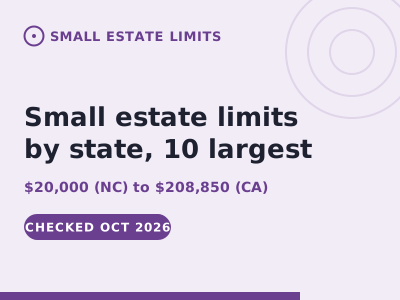
New York small estate affidavit: $50,000 limit, no waiting period and a $1 filing fee under SCPA article 13
New York's small estate procedure, called voluntary administration under article 13 of the Surrogate's Court Procedure Act (SCPA), is available when the person who died left personal property with a gross value of $50,000 or less, not counting property set off for a surviving spouse or children under 21 under EPTL 5-3.1(a). There is no waiting period after the death, the filing fee is $1, and the procedure does not reach real property. The $50,000 figure has applied to proceedings commenced since the law raising it from $30,000 was signed on November 25, 2019.
- Dollar limit
- $50,000 gross value of personal property
- Not counted
- Property set off under EPTL 5-3.1(a) for a surviving spouse or children under 21
- Waiting period
- None (SCPA 1304(1))
- Real estate
- Not covered (SCPA 1302); see the section below for how the courts' page treats real property
- Filed with
- The Surrogate's Court clerk of the county of the decedent's domicile; no court order
- Filing fee
- $1 (SCPA 1304(4)); the courts' page says $1.00
- Bond
- Not required (SCPA 1304(2))
- First right to act
- With a will: the named executor or alternate executor. Without a will: the surviving adult spouse (SCPA 1303)
- Limit last changed
- November 25, 2019 (chapter 557 of the Laws of 2019; previously $30,000)
Figures above were read from SCPA sections 1301, 1302 and 1304 (on 2026-10-11) and SCPA 1303 and EPTL 5-3.1 (on 2026-10-12) on the New York State Senate's law site, from the New York Courts' small estate page (on 2026-10-12) and from the 2019 bill record on the New York State Assembly's site (on 2026-10-12). See sources.
This page is general information, not legal advice. Whether voluntary administration fits depends on the facts of the estate; a probate attorney or the Surrogate's Court clerk can help with a specific case.
The $50,000 test in SCPA 1301
Section 1301(1) defines a small estate as the estate of a domiciliary or a non-domiciliary who dies leaving "personal property having a gross value of $50,000 or less exclusive of property required to be set off under EPTL 5-3.1 (a)."
- Personal property only. The test counts the decedent's personal property. Real property is outside article 13 (see below).
- Gross value. The statute uses the gross value of the personal property. It does not say that debts are subtracted.
- Family set-off excluded. Property that EPTL 5-3.1(a) requires to be set off does not count toward the $50,000. The amounts are listed in the next section.
Section 1301(2) describes the voluntary administrator as a person who qualifies and undertakes to settle the estate "without the formality of court administration".
The New York Courts' page on small estates describes the test in different words: "When the person who died (the Decedent) had less than $50,000 of personal property then it's considered a small estate, and is called a Voluntary Administration." The statute says "$50,000 or less"; the courts' page says "less than $50,000".
Property set off for the family (EPTL 5-3.1)
EPTL 5-3.1(a) applies "If a person dies, leaving a surviving spouse or children under the age of twenty-one years". The listed items "are not assets of the estate" and are set off to the surviving spouse, unless the spouse is disqualified under 5-1.2. If there is no surviving spouse, or the spouse is disqualified, they are set off to the decedent's children under 21.
| Item in EPTL 5-3.1(a) | Value limit |
|---|---|
| (1) Housekeeping utensils, musical instruments, sewing machine, jewelry unless disposed of in the will, clothing of the decedent, household furniture and appliances, electronic and photographic devices, and fuel for personal use (not items used only for business) | $20,000 in aggregate |
| (2) Family bible or other religious books, family pictures, books, computer tapes, discs and software, DVDs, CDs, audio tapes, record albums and other electronic storage devices used by the family | $2,500 |
| (3) Domestic and farm animals with 60 days of food, farm machinery, one tractor and one lawn tractor | $20,000 in aggregate |
| (5) One motor vehicle | $25,000 |
| (6) Money, including cash, checking, savings and money market accounts, certificates of deposit and marketable securities | $25,000, reduced by any excess value of items acquired under (1), (2), (3) and (5) |
Other points in the section:
- The section defines the term "value" as the fair market value of each item, reduced by outstanding security interests or other encumbrances (5-3.1(d)).
- The spouse or children may take items in (1), (2), (3) and a vehicle worth more than the limit by paying the estate the excess (5-3.1(a)(4) and (5)). Instead of the vehicle, they may elect cash equal to its value, up to $25,000.
- For the money in (6): "However, where assets are insufficient to pay the reasonable funeral expenses of the decedent, the personal representative must first apply such money to defray any deficiency in such expenses."
- No money or other property is allowed in place of items in (1), (2), (3) or (5) that did not exist when the decedent died (5-3.1(b)).
Real estate: the statute and the courts' page
Section 1302 says: "This article is not applicable to any interest in real property in this state owned by a decedent". The same section adds that owning an interest in real property does not prevent the use of article 13 to administer the decedent's personal property.
The New York Courts' page gives these examples:
- "If the Decedent owned real property, like a house or land, in their name alone then IT IS NOT a small estate anymore."
- "If Decedent owned real property jointly with another person and had less than $50,000 of personal property, then IT IS a small estate."
- With real property and a will, the page says a probate proceeding should be filed; with real property and no will, an administration proceeding.
The statute's wording (owning real property does not prevent use of article 13 for personal property) and the courts' page (real property in the decedent's name alone means it is not a small estate) are worded differently. The State Comptroller's page, below, also describes the voluntary administration estate as having "no real property."
A possible lawsuit
The courts' page adds a caution: "In some cases, there is a possibility of a wrongful death or other lawsuit in the future." In that case, it says, a probate or administration proceeding should be filed instead, even if there is less than $50,000 of personal property at the time of death.
Who can be the voluntary administrator (SCPA 1303)
- With a will (1303(b)): "the named executor or alternate executor shall have the first right to act as voluntary administrator, upon filing the last will and testament with the surrogate's court." If the executor or alternate renounces, or does not file the affidavit within 30 days after the will is filed, any adult person who would be entitled to petition for letters of administration with will annexed under section 1418 may file the affidavit and act.
- Without a will (1303(a)): the right goes "first to the surviving adult spouse, if any, of the decedent". If there is none, or the spouse renounces, it goes in order to a competent adult who is a child or grandchild, parent, brother or sister, niece or nephew, or aunt or uncle. Next come the guardian, committee or conservator of the property of a distributee who is an infant, incompetent or conservatee. If none of these will act, or there are no known distributees in those categories, the right goes to the chief fiscal officer of the county, except in counties where a public administrator has been appointed under articles 11 and 12.
- No one else (1303(c)): "No person other than one hereinbefore mentioned can become a voluntary administrator."
The courts' page puts it more briefly: "If there is a Will, the Executor of the Will is appointed the Voluntary Administrator. If there is no Will, then the closest relative is named the Voluntary Administrator."
How the procedure works under SCPA 1304
- No waiting period. Section 1304(1): "No waiting period after the death of the decedent is required."
- File the affidavit and death certificate. The person files, with the clerk of the court of the decedent's domicile (for a non-domiciliary, the county where the personal property is located), an affidavit in the form provided by the Official Forms appended to the SCPA and a certified copy of the death certificate (section 1304(3)). The courts' page says the papers are filed "in the Surrogate's Court in the county where the Decedent had their primary residence", and that when there is a will, the executor files the original will with them.
- No bond. Section 1304(2): "The voluntary administrator need not give a bond."
- The clerk files it. The clerk files the affidavit, assigns it a number and enters it in the court's records. "The clerk shall charge a fee of $1 for filing the affidavit." The courts' page says: "The filing fee is $1.00." Section 1304(4) also says: "No order of the court or other proceeding shall be necessary."
- Notice to family and beneficiaries. The clerk mails a letter or postcard notice to each distributee who has not renounced and to each beneficiary named in the affidavit, other than the affiant. The statute says: "The giving of such notice is not jurisdictional."
- The certificate. A short certificate of the court showing the affidavit was filed is the evidence of the voluntary administrator's authority (section 1304(5)). "The clerk may indicate on the certificate that it is valid only for a transfer or transaction as specified thereon." The voluntary administrator delivers a certificate to each bank, transfer agent or other holder of the decedent's personal property. The courts' page says the court "issues a certificate for each asset listed in the papers".
For preparing the papers, the courts' page points to its Small Estate DIY (Do-It-Yourself) Form program, which it says "walks you step-by-step to complete the paperwork you need".
What changed in 2019
The limit was $30,000 until 2019. Senate bill S4951A (Assembly companion A7571-A), summarized on the Assembly's bill page as "Relates to raising the value of a small estate from $30,000 to $50,000.", amended section 1301(1). Section 2 of the bill says: "This act shall take effect immediately" and applies to actions and proceedings commenced on or after that date.
| Date | Step |
|---|---|
| 2019-04-02 | S4951 referred to the Senate Judiciary Committee |
| 2019-06-12 | Passed the Senate |
| 2019-06-17 | Passed the Assembly |
| 2019-11-19 | Delivered to the governor |
| 2019-11-25 | Signed as chapter 557 of the Laws of 2019; limit $50,000 for proceedings commenced on or after this date |
The bill text shows the subdivision had last been amended by chapter 281 of the Laws of 2012, and the $30,000 figure in brackets as the old law. The bill ties the new limit to when the proceeding is commenced (on or after its effective date); it does not refer to the date of death.
Unclaimed funds held by the State Comptroller
The Office of the New York State Comptroller's page on claims for deceased owners lists the Certificate of Voluntary Administration as the court appointment for an estate described as "Less than $50,000 of personal property, no real property." The statute's test is "$50,000 or less", with the real property rule in section 1302 described above. The Comptroller's page also says:
- "The certificate of appointment must be dated within six months of when the claim is submitted."
- When there is no court-appointed representative, the Comptroller says it may process a claim by the closest living family member for funds worth less than $1,000, made with a Small Estates Affidavit and Table of Heirs; for $1,000 or more, only a court-appointed representative may complete the claim.
- A payer of funeral expenses may claim reimbursement of up to $5,000 when there is no court-appointed representative.
What we could not confirm
- The number and wording of the official affidavit form, including what the form says is left out of the count (for example jointly owned or payable-on-death accounts), and what clerks charge for each certificate. We did not open the forms or the DIY program itself.
- The New York County Surrogate's Court small estate checklist (https://www.nycourts.gov/LegacyPDFS/courts/1jd/surrogates/a)%201.%20%20NY%20County%20Checklist-%20Small%20Estates-Voluntary%20Administration.pdf). nycourts.gov returned an error to automated requests.
- The text of SCPA 1306 (https://www.nysenate.gov/legislation/laws/SCP/1306, powers of the voluntary administrator) and 1310 (https://www.nysenate.gov/legislation/laws/SCP/1310, payment of certain debts, such as bank deposits and wages, without administration). nysenate.gov returned an error to automated requests.
- The Department of Motor Vehicles' rules and forms for transferring a vehicle of a deceased owner. dmv.ny.gov returned an error to automated requests.
- Any pending bill to change the $50,000 limit. We did not find one, but we did not search every bill of the 2025-2026 session.
Questions
What is the small estate affidavit limit in New York?
Is there a waiting period before filing?
Can a house be transferred with a New York small estate affidavit?
How much does it cost to file?
Who can file if there is no will?
Sources
- SCPA section 1301, Definitions - New York State Senate, Laws of New York, read 2026-10-11
- SCPA section 1302, Kinds of property - New York State Senate, Laws of New York, read 2026-10-11
- SCPA section 1303, Persons who may become a voluntary administrator - New York State Senate, Laws of New York, read 2026-10-12
- SCPA section 1304, Summary procedure - New York State Senate, Laws of New York, read 2026-10-11
- EPTL section 5-3.1, Exemption for benefit of family - New York State Senate, Laws of New York, read 2026-10-12
- Small Estate - When a Person Dies with less than $50,000 - New York Courts, read 2026-10-12
- S4951A (2019), summary, actions and text - New York State Assembly, bill search, read 2026-10-12
- Claims for Deceased Owners and Estates - Office of the New York State Comptroller, read 2026-10-12
Source links are not affiliate links. This page is general information, not legal, tax or financial advice.