Colorado small estate affidavit: $88,000 limit for 2026 deaths, 10-day wait, form JDF 999
For a death in 2026, Colorado's collection of personal property by affidavit (C.R.S. 15-12-1201, court form JDF 999) can be used when the estate is worth no more than $88,000, less liens and encumbrances, and at least 10 days have passed since the death. The figure depends on the year of death, not the year the affidavit is signed: it is $86,000 for a 2025 death and $82,000 for a 2024 death. The current JDF 999, revised April 28, 2026, prints each figure back to 2020.
We record each state's limit, waiting period and official forms, with the statute and the date we checked. This page is general information, not legal or tax advice. Whether an estate qualifies depends on the facts, and the rules differ from state to state.
- Limit for 2026 deaths
- $88,000, less liens and encumbrances
- Limit for 2025 deaths
- $86,000
- How the limit is set
- Twice the exempt property amount in C.R.S. 15-11-403 ($30,000 base), adjusted each year under C.R.S. 15-10-112
- Which year counts
- The year of death
- Waiting period
- 10 days after the death (no wait for property held by a public administrator)
- Real estate
- The affidavit is not valid to transfer real estate
- Court form
- JDF 999, Collection of Personal Property by Affidavit (R: April 28, 2026)
- Court guide
- JDF 998, Guide to Collecting a Decedent's Personal Property (R: March 19, 2026)
- Filed with a court?
- No; no filing fee
- Vehicles
- The DMV uses its own affidavit, DR 2712, according to JDF 998
- Who publishes the figures
- Colorado Department of Revenue, before February 1 each year (C.R.S. 15-10-112(3))
- Checked
- 2026-10-13
Figures above were read from Colorado Revised Statutes 2026, Title 15 (the Office of Legislative Legal Services download), and from the Colorado Judicial Branch's JDF 999 and JDF 998 on 2026-10-13. See sources.
The limit for each year of death
Section 15-12-1201(1)(a) requires the affidavit to state that the decedent's property, less liens and encumbrances, "does not exceed twice the amount set forth in section 15-11-403, as adjusted by section 15-10-112". Section 15-11-403(1)(b) sets the exempt property amount for deaths on and after January 1, 2012 at "thirty thousand dollars in excess of any security interests therein". Section 15-10-112 adjusts that amount using "the CPI for the calendar year immediately preceding the year of death", so the year of death decides which figure applies.
The statute does not print a dollar figure. The court forms do. The table below takes each year from the current JDF 999 where it is printed, and from a superseded 2021 revision of the same form for earlier years.
| Year of death | Affidavit limit | Where the figure is printed |
|---|---|---|
| 2026 | $88,000 | JDF 999 (R: April 28, 2026) and JDF 998 (R: March 19, 2026) |
| 2025 | $86,000 | JDF 999 (R: April 28, 2026) and JDF 998 |
| 2024 | $82,000 | JDF 999 (R: April 28, 2026) and JDF 998 |
| 2023 | $80,000 | JDF 999 (R: April 28, 2026) and JDF 998 |
| 2022 | $74,000 | JDF 999 (R: April 28, 2026) and JDF 998 |
| 2020 - 2021 | $70,000 | JDF 999 (R: April 28, 2026) and JDF 999 (R2/21) |
| 2019 | $68,000 | JDF 999 (R2/21), archived copy |
| 2017 - 2018 | $66,000 | JDF 999 (R2/21), archived copy |
| 2014 - 2016 | $64,000 | JDF 999 (R2/21), archived copy; SSA manual for 2014 |
| 2013 | $63,000 | JDF 999 (R2/21), archived copy; SSA manual |
| 2012 | $61,000 | SSA manual only; not confirmed on a Colorado source |
| 2010 - 2011 | $60,000 | SSA manual only; not confirmed on a Colorado source |
$88,000 is twice $44,000, so the 2026 row implies an adjusted exempt property amount of $44,000. We could not read the Department of Revenue's list that should show that figure (see below), so the $44,000 is our arithmetic from the form, not a figure we read in a state publication.
Section 15-10-112(2) rounds the yearly increase down: "the amount of the increase or decrease is rounded down if it is an increase, or rounded up if it is a decrease, to the next multiple of one thousand dollars". Because the result is then doubled, the affidavit limit under the current formula is always a multiple of $2,000. The 2013 figure of $63,000 does not fit that pattern. The statute's history notes list amendments to subsection (1)(a) in 2011 (SB 11-083) and 2014 (HB 14-1322); we did not read the earlier wording.
Who publishes the yearly figures
Section 15-10-112(3) says: "Before February 1, 2012, and before February 1 of each succeeding year, the department of revenue shall publish a cumulative list". The court's guide, JDF 998, sends readers there for older years: "For additional Y.O.D. values, see the Department of Revenue’s website for fiduciary income tax filing information." The Colorado Judicial Branch then prints the figures on JDF 999 and JDF 998.
We could not read the Department of Revenue's list: the tax.colorado.gov server refused automated access on 2026-10-13. The figures on this page therefore come from the court forms, which are themselves official publications of the Colorado Judicial Branch.
What the affidavit must say
Under section 15-12-1201(1), at any time ten or more days after the death, anyone who owes the decedent money or holds the decedent's personal property must pay or deliver it to a successor, or a person acting for a successor, who presents an affidavit stating all of these:
- The value of "property owned by the decedent and subject to disposition by will or intestate succession", wherever located, less liens and encumbrances, is within the limit.
- "At least ten days have elapsed since the death of the decedent".
- No application or petition to appoint a personal representative is pending or has been granted in any jurisdiction.
- Each person named is entitled to the payment or property as the affidavit sets out.
The statute's list, which is not limited to these, includes funds on deposit at a financial institution, the contents of a safe deposit box, tangible personal property, and an instrument for a debt, obligation, stock, chose in action or stock brand. A transfer agent must re-register a security in the successor's name when shown the affidavit (section 15-12-1201(2)).
"Successors" are defined in section 15-10-201(51) as "persons other than creditors, who are entitled to property of a decedent under his or her will or this code". The JDF 999 form adds that the person signing says "I am 18 years of age or older" and signs before a notary.
A holder who pays under the affidavit is released as if it had dealt with a personal representative (section 15-12-1202(1)). If the people entitled to the property prove their right in a court proceeding, a holder that refused without reasonable cause is liable for their costs, including reasonable attorney fees (section 15-12-1202(2) and (3)).
The 10-day wait, and one exception
The ten days run from the date of death. There is one exception in the statute. When the public administrator for a judicial district is protecting the decedent's property, section 15-12-620(2) says: "The ten-day waiting period required in section 15-12-1201 (1)(b) shall not apply to affidavits presented to a public administrator to obtain property being protected by a public administrator pursuant to this section."
Form JDF 999 and guide JDF 998: current revisions
The affidavit is JDF 999, Collection of Personal Property by Affidavit. The PDF we read on the Colorado Judicial Branch website is marked "R: April 28, 2026". The guide, JDF 998, is titled Guide to Collecting a Decedent's Personal Property and is marked "R: March 19, 2026". Both print the same year-of-death figures, 2020 through 2026.
Nothing goes to the court. JDF 998 says: "This process does not require a filing with the Court." It also says: "No filing fee is required, as this document is not filed with the Court." The guide's steps are to complete the affidavit, sign it before a notary, attach a copy of the death certificate (some holders may require a certified copy) and present both to the holder, such as a bank.
Two small inconsistencies in the court's own materials, for readers comparing documents. JDF 998 still refers to distributing property "as specified in #6 of the affidavit"; the current JDF 999 lists successors in paragraph 2(f), while paragraph 6 was the numbering in the 2021 revision. And the Judicial Branch's "Open an Estate" self-help page still calls JDF 998 "Instructions for Completing Affidavit for the Collection of Personal Property", the older title.
Real estate
Paragraph 2(d) of JDF 999 says: "This affidavit is not valid for the transfer of real estate." JDF 998 says the affidavit "cannot be used to transfer real estate but may only be used to collect personal property."
There is one link to real estate. When the decedent held a mortgage, deed of trust or other debt secured by someone's real property, section 15-12-1201(3.5) requires the person making the affidavit to record a copy of the affidavit and a copy of the death certificate (or a verification of death) with the clerk and recorder of the county where the real property is located.
The statute's value test does not use the words "personal property". It measures "property owned by the decedent and subject to disposition by will or intestate succession", wherever located. How that applies to a given estate depends on the facts.
Vehicles
Section 15-12-1201(3) says "The public official having cognizance over the registered title of any personal property of the decedent shall change the registered ownership from the decedent to the successor or successors" when shown the affidavit. The court's guide says the DMV uses its own form instead: the DMV "will NOT accept JDF 999 but instead requires the use of its own affidavit (DR 2712)" for motor vehicles, motorcycles, motor homes and similar vehicles.
Title 42 also refers to this route. Section 42-6-110.5(2.6) protects a successor from liability for "transferring title to the vehicle by an affidavit executed in accordance with section 15-12-1201" when the successor does not know of a valid beneficiary designation. Section 42-6-110.5 lets an owner name a "transfer on death" beneficiary for a vehicle on a beneficiary designation form the Division of Motor Vehicles makes available; the beneficiary presents that form with proof of death and the title fee.
We could not read DR 2712 itself (see below), so its revision date and the years it lists are not confirmed on this page.
Where an old figure still appears
- Social Security Administration manual. POMS GN 02315.042, Colorado - Small Estates, shows effective dates "10/09/2014 - Present". It says "Colorado law permits collection and distribution of small estates under $60,000 by affidavit." and lists figures only through a 2014 death ($64,000). For a 2026 death the court form's figure is $88,000.
- The 2021 court form. The archived JDF 999 (R2/21) tops out at $70,000 for 2020 and 2021 deaths. It is no longer the form linked by the Judicial Branch, but copies of older revisions can still circulate.
- The DMV form. Not confirmed. We could not read DR 2712 to check which years it lists.
What we could not confirm
- The Department of Revenue's cumulative list under C.R.S. 15-10-112(3), including the $44,000 exempt property amount for 2026 deaths. The tax.colorado.gov server returned HTTP 403 to every automated request on 2026-10-13, including the file at tax.colorado.gov/sites/tax/files/documents/Probate_Index_2026.xlsx.
- The DMV's DR 2712 affidavit, its revision date and the years it lists. dmv.colorado.gov returned HTTP 403 on 2026-10-13.
- The 2012 and 2010 - 2011 figures ($61,000 and $60,000) appear only in the Social Security manual, which prints the earlier years as "2011 and 21010" (we read this as 2010); we did not find them on a Colorado source we could read.
- The statute's wording before the 2014 amendment, which would explain the 2013 figure of $63,000.
- The Colorado Legal Services page at lawhelp.colorado.gov, which robots.txt does not allow us to read.
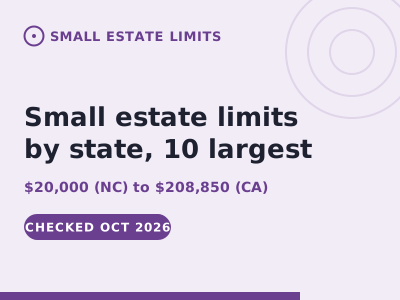
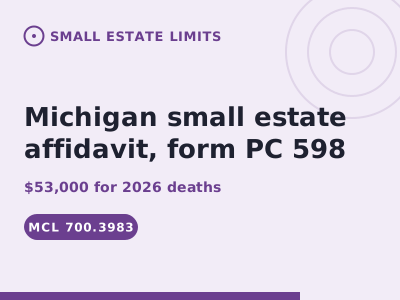
For limits in other states, see small estate affidavit limits by state. Michigan also adjusts its limit every year by year of death; see Michigan small estate affidavit. About this site: about.
Questions
What is the Colorado small estate affidavit limit for 2026?
Does the year of death or the year of signing decide the limit?
How long do you have to wait to use the Colorado small estate affidavit?
Is JDF 999 filed with the court?
Can the Colorado small estate affidavit transfer a house or a car?
Sources
- C.R.S. 15-12-1201, 15-12-1202, 15-12-620, 15-11-403, 15-10-112 and 15-10-201(51), Colorado Revised Statutes 2026, Title 15 (uncertified printout, current through the 2026 regular session) - Office of Legislative Legal Services, Title 15 PDF, read 2026-10-13
- C.R.S. 42-6-110.5, Colorado Revised Statutes 2026, Title 42 - Office of Legislative Legal Services, Title 42 PDF, read 2026-10-13
- 2026 CRS titles for download (links to the Title 15 and Title 42 files) - Colorado General Assembly, read 2026-10-13
- JDF 999, Collection of Personal Property by Affidavit (R: April 28, 2026) - Colorado Judicial Branch, read 2026-10-13
- JDF 998, Guide to Collecting a Decedent's Personal Property (R: March 19, 2026) - Colorado Judicial Branch, read 2026-10-13
- Open an Estate (self-help page) - Colorado Judicial Branch, read 2026-10-13
- JDF 999 (R2/21), superseded revision, copy archived June 24, 2021 - Internet Archive, read 2026-10-13
- POMS GN 02315.042, Colorado - Small Estates - Social Security Administration, read 2026-10-13
Source links are not affiliate links. This page is general information, not legal, tax or financial advice.