California DMV REG 5: transferring a car or boat title after the owner dies, and why the form still says $184,500
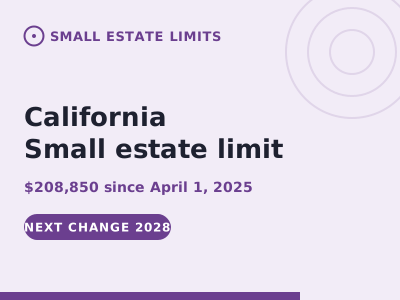
When a California vehicle or vessel owner dies and there is no probate, the California DMV lets the person entitled to it transfer the title with the death certificate and form REG 5, the Affidavit for Transfer Without Probate, once at least 40 days have passed since the death. The current REG 5 (REV. 12/2024), read on 2026-10-12, still prints a value cap of $184,500 for deaths on or after April 1, 2022, while the Judicial Council's Probate Code section 890 table gives $208,850 for deaths on or after April 1, 2025.
- DMV form
- REG 5, Affidavit for Transfer Without Probate, California Titled Vehicle or Vessel Only (REV. 12/2024)
- Waiting period on the form
- At least 40 days after the death
- Cap printed on REG 5
- $166,250 (death before April 1, 2022); $184,500 (death on or after April 1, 2022)
- Law since Apr. 1, 2025
- $208,850 (Probate Code sections 13100, 13101)
- Also required
- Copy of the death certificate; the California Certificate of Title
- DMV transfer fee
- $15 (Vehicle Code section 9255)
- Use tax
- DMV manual lists inheritance with a REG 5 as not subject to use tax
- Out-of-state titles
- REG 5 cannot be used for vehicles not titled in California
Figures above were read from the DMV form REG 5, the DMV fee page and the DMV Vehicle Industry Registration Procedures Manual, and from the Judicial Council of California's section 890 table, on 2026-10-12. See sources.
This page is general information, not legal or tax advice. Whether a procedure fits depends on the facts of the estate and the way the vehicle is titled.
The dollar figure on REG 5 and the current Probate Code amount
REG 5 contains a sworn statement that the decedent's California property, after the listed exclusions, does not exceed a stated amount. The December 2024 revision lists two amounts. The second reads: “One hundred eighty-four thousand, five hundred dollars ($184,500) if the decendent died on or after April 1, 2022.” (The form spells the word that way.)
The Judicial Council's table of adjusted amounts under Probate Code section 890 splits the same period in two: $184,500 for deaths from April 1, 2022 through March 31, 2025, and $208,850 for deaths on or after April 1, 2025, for sections 13100 and 13101. Form DE-300 (Rev. April 28, 2025) gives the same $208,850. The REG 5 form has no line for a death on or after April 1, 2025.
Other official pages we read on 2026-10-12 also show older amounts, listed below so readers can see which document says what.
| Document | Revision or page | Amount stated | Death dates it is stated for |
|---|---|---|---|
| Judicial Council section 890 table | Adjusted April 1, 2025 | $208,850 | On or after April 1, 2025 |
| Judicial Council form DE-300 | Rev. April 28, 2025 | $208,850 | On or after April 1, 2025 |
| DMV form REG 5 | REV. 12/2024 | $184,500 | On or after April 1, 2022 |
| DMV form REG 5 | REV. 12/2024 | $166,250 | Before April 1, 2022 |
| California Courts Self-Help Guide, small estate page | Page text read 2026-10-12 | $184,500 | April 1, 2022, or later |
| DMV Vehicle Industry Registration Procedures Manual, section 11.065 | Section heading | $150,000 | No date range stated |
| Older DMV copy of REG 5 still online | REV. 9/2017 | $150,000 | No date range stated |
We did not find a DMV page that says which amount the DMV applies for a death on or after April 1, 2025. The Judicial Council table ends with this line: “Unless otherwise provided by statute, these amounts will next be adjusted on April 1, 2028.” For the rest of California's limits, see our California small estate limit page.
What the REG 5 affidavit says
The person or persons signing REG 5 state, under penalty of perjury, that:
- The decedent left no other property that requires probate, and no probate proceeding is being or has been conducted in California for the estate.
- There are no unsecured creditors, or they have been paid in full or their claims otherwise discharged.
- At least 40 days have passed since the death.
- The gross fair market value of the decedent's real and personal property in California, excluding the property described in Probate Code section 13050 and property in a listed petition, does not exceed the amount printed on the form.
- No one has a superior right to the vehicle or vessel.
The form lists three kinds of signers: the heir or heirs under Probate Code sections 6401 and 6402 when there is no will, or the beneficiary or beneficiaries under the will; a trustee of a trust the decedent set up; or a conservator or guardian of the estate of the person or persons who inherit. The top of the form says a copy of the death certificate is required. Section 2 of the form says the person who gets the transfer is subject to Probate Code sections 13109 through 13113 to the same extent as a person who receives property under the small estate affidavit chapter.
One citation on the form differs from the court form. REG 5 excludes “any property included in a petition filed under CPROB §13051”. Form DE-300, describing the same value test for sections 13100 and 13101, excludes “any property included in a petition filed under Probate Code section 13151”. We record both as printed.
The California Courts Self-Help Guide lists “Cars, boats, or mobile homes” among the items not to include when adding up the value of an estate for the small estate procedure.
California titles only
The DMV manual's section on estates says: “The REG 5 cannot be submitted for vehicles not titled in California.” The manual's use tax chapter adds that a REG 5 is not acceptable for nonresident vehicles and that an out-of-state title must be transferred in the state of origin before California registration.
What the DMV asks for
The DMV's Title Transfers and Changes page lists the deceased-owner case as: an heir may transfer with the death certificate and REG 5, with value limits applying. The manual's basic transfer requirements, which apply in addition to the estate section, include:
- The California Certificate of Title, endorsed for transfer. If the title is missing, the DMV page says to complete form REG 227 (Application for Replacement or Transfer of Title) first.
- Release of any lienholder on line 2 of the title or on form REG 166.
- Odometer mileage disclosure on the title or on form REG 262, where required.
- The new owner's name, address and driver's license or ID number.
- A smog certification, if required, or evidence of exemption.
- The transfer fee and any other fees, and use tax or evidence of exemption. The manual says the transfer fee must be paid within 30 days of the date of transfer to avoid a late penalty.
The DMV page gives the mailing address as DMV, PO Box 942869, Sacramento, CA 94269, or a DMV office.
Fees and use tax
| Item | Amount | Basis shown by DMV |
|---|---|---|
| Transfer fee | $15 | Vehicle Code section 9255 |
| Transfer fee penalty | $15 | Vehicle Code section 9553.7 |
| Smog transfer fee | $8 | Vehicle Code section 4000.1 |
| Replacement title | $28 | Vehicle Code section 9265 |
| Transfer on death beneficiary designation | $10 | Vehicle Code sections 4150.7, 9852.7 |
The DMV manual lists inheritance among transactions not subject to use tax. It says an application for a vehicle or vessel bequeathed to the applicant must include either a REG 5 completed by the applicant or a Statement of Facts (REG 256) from a surviving co-owner stating the vehicle was bequeathed to the applicant. Form REG 256 (REV. 8/2008) has “Court Order” and “Inheritance” boxes in its use tax exemption section, and a smog exemption section that lists transfers from a parent, grandparent, child, grandchild, brother, sister, spouse or domestic partner, with a note that biennial smog can still be required.
Co-owners: “and”, “or”, JTRS, tenants in common, community property
How a co-owned title is worded decides whether REG 5 is used at all. The DMV manual says: “A REG 5 cannot be used to circumvent the interest of a surviving owner when the vehicles are jointly owned by two or more persons and one of the owners is deceased.”
| How the title shows the owners | What the DMV manual says happens at a co-owner's death |
|---|---|
| Joined by “and” (or a slash between names) | Ownership passes to the surviving co-owner. The deceased co-owner's interest may be released only by an heir with REG 5, an administrator with Letters of Administration, or an executor with Letters Testamentary. |
| Joined by “or” or “and/or” | The signature of one owner transfers ownership. A surviving co-owner's signature releases all owners' interest unless “Tenants in Common” or “COMPRO” follows the names. |
| JTRS (joint tenants with right of survivorship) | The surviving co-owner releases interest. A copy of the deceased owner's death certificate must accompany the application. |
| Tenants in Common | The deceased co-owner's interest goes to that co-owner's estate, not the survivor. Transfer with Letters Testamentary, Letters of Administration or REG 5. |
| COMPRO (community property) | Ownership passes to the surviving owner after the deceased co-owner's interest is released by an heir with REG 5 (if the estate was not probated), an administrator or an executor. |
| TOD beneficiary named | See the transfer on death section below. |
When the surviving owner is also the heir, the manual says that person may complete a REG 5 to release the deceased owner's interest, and the title must be signed twice: once by the surviving owner and once for the deceased owner, countersigned by the heir. If two or more owners have died, the manual calls for a REG 5 for the most recently deceased owner and a death certificate for each owner.
Transfer on death (TOD) titles
The DMV manual, section 11.170, says a registered owner may name a transfer on death beneficiary on the title. Only one registered owner name and one beneficiary name are allowed on a TOD title, and the beneficiary's signature is not needed to add, change or delete a beneficiary. The DMV fee page lists a $10 fee for a TOD beneficiary designation; the manual section says a transfer fee applies to add, delete or change a beneficiary.
After the owner's death, the manual lists two documents for the transfer to the beneficiary: the California Certificate of Title, on which the beneficiary signs the registered owner's name and countersigns on line 1, and a Statement of Facts (REG 256) in which the beneficiary states the date and place of death and that they are entitled to the vehicle as the designated beneficiary. The manual's use tax chapter lists a transfer to the TOD beneficiary as not subject to use tax.
The DMV pages we read name no separate TOD form. Form REG 4008 on the DMV's title forms list is the Declaration of Gross Vehicle Weight/Combined Gross Vehicle Weight, not a beneficiary form.
When Letters or a court order are involved
- Probate distribution. The manual's estate section says: “A copy of the court order authorizing the distribution of property must accompany the transfer application.” It adds that the court order does not have to identify the vehicle.
- Executor or administrator. For co-owned titles, the manual names Letters Testamentary (executor) and Letters of Administration (administrator) as ways to release a deceased co-owner's interest.
- Transfer to “Estate of”. Manual section 11.175 says a vehicle may be transferred from the decedent to “Estate of (name of decedent)” without signatures on the title, with a REG 256 declaring that Letters Testamentary have not been issued and the relationship of the person completing it, plus a transfer fee. It says: “Use tax and a smog certification are not required.”
- Public administrator. Section 11.065 also has rows for property being liquidated by a public administrator, using the same older dollar figures as its heading.
What we could not confirm
- Which value cap the DMV applies in practice for a death on or after April 1, 2025, when REG 5 (REV. 12/2024) prints $184,500. We looked at the REG 5 file, the DMV Title Transfers and Changes page, the Gift or Inheritance checklist and manual sections 1.035, 4.035, 11.015, 11.065, 11.170 and 11.175. None addresses it.
- Whether the “§13051” reference on REG 5 is intended to read 13151. We compared it only with form DE-300; we did not read the statute text.
- The exact title signatures for a sole owner's vehicle transferred with REG 5. The manual sections we read spell them out for co-owned and TOD titles only.
- Whether a smog certification is required for an inherited vehicle that is not going to a listed family member. The DMV smog page and REG 256 address family transfers and gifts, not inheritance as such.
- The odometer rule for older vehicles. Manual section 5.000 describes disclosure for vehicles nine model years old and newer, and the DMV's Gift or Inheritance checklist says “less than 10 years old”; we did not find a DMV page with a newer rule.
- Vessel fees. The fee table above is for vehicles; we did not read the DMV vessel fee schedule.
- The DMV's “Gift or Inheritance Title Transfer” checklist (PDF), read on 2026-10-12, describes only gifts; it has no inheritance or deceased-owner steps.
Questions
What is the REG 5 form?
How long after a death can a California car title be transferred with REG 5?
Does REG 5 still say $184,500?
Is REG 5 needed if the title says “or” between the names?
How much does the DMV charge to transfer a deceased owner's car?
Sources
- Form REG 5, Affidavit for Transfer Without Probate, California Titled Vehicle or Vessel Only (REV. 12/2024) - California DMV (PDF), read 2026-10-12
- Older copy of form REG 5 (REV. 9/2017) - California DMV (PDF), read 2026-10-12
- Title Transfers and Changes - California DMV, read 2026-10-12
- Registration Fees - California DMV, read 2026-10-12
- Gift or Inheritance Title Transfer checklist - California DMV (PDF), read 2026-10-12
- Form REG 256, Statement of Facts (REV. 8/2008) - California DMV (PDF), read 2026-10-12
- Smog Inspections - California DMV, read 2026-10-12
- Vehicle Industry Registration Procedures Manual, 1.035 Co-Owners - California DMV, read 2026-10-12
- Vehicle Industry Registration Procedures Manual, 4.035 Transactions Not Subject to Use Tax - California DMV, read 2026-10-12
- Vehicle Industry Registration Procedures Manual, 5.000 Odometer Mileage Reporting - California DMV, read 2026-10-12
- Vehicle Industry Registration Procedures Manual, 11.015 Basic Transfer Requirements - California DMV, read 2026-10-12
- Vehicle Industry Registration Procedures Manual, 11.065 Estate Valued at $150,000 or Less - California DMV, read 2026-10-12
- Vehicle Industry Registration Procedures Manual, 11.170 Transfer on Death (TOD) Beneficiary - California DMV, read 2026-10-12
- Vehicle Industry Registration Procedures Manual, 11.175 Transfer to “Estate of” - California DMV, read 2026-10-12
- Maximum Amounts for Determining Eligibility for Summary Succession Procedures (Probate Code section 890 table) - Judicial Council of California (PDF), read 2026-10-12
- Form DE-300, Maximum Values for Small Estate Set-Aside & Disposition of Estate Without Administration (Rev. April 28, 2025) - Judicial Council of California (PDF), read 2026-10-12
- Small estate affidavit to transfer personal property - California Courts Self-Help Guide, read 2026-10-12
- When formal probate may not be needed - California Courts Self-Help Guide, read 2026-10-12
Source links are not affiliate links. This page is general information, not legal, tax or financial advice.